

Turquoise is beautiful! We wear a lot of it in the Southwest, wrapped in silver and as lovely as the sky. Native American's have been mining Turquoise and creating ritual items and jewelry for ages. Even today some of the best and most coveted jewelry are Native American made. Turquoise comes in many variations of blue and green. Often finding turquoise in the wild is a precursor to locating copper ore. Arizona is a top producer of mined copper.
Many stunning stones have differences to them that tell where they came to be located from. How green or blue or even white, vein differences or lack of are ways to detect origin. Here in and near Arizona my husband and I have had the wonderful opportunity to visit locations, mines and towns where turquoise is found. In my husbands eyes and the mines that work with him...turquoise is kinda a by-product. He's a Mining Engineer with Mintec. Inc, in sunny Tucson AZ. They create and internationally install mining software(Minesight), turning data into 3-D imaging and create those huge mines across the globe. There are many, many mines in the southwest. The following are a few that my husband has visited, I been to a few of these too.

Bisbee Turquoise
The Bisbee mine, near Bisbee, Arizona, is one of the more famous of the American mines because Bisbee turquoise was one of the first put onto the market. The turquoise mine is part of the Bisbee copper mine, the main operation of the site. Bisbee turquoise has developed a reputation as a hard, finely webbed, strikingly brilliant blue stone of a high quality. The unusual matrix forms wisps or veils throughout the stone, often called "Smoky Bisbee." The highest grade of Bisbee is found at less then 100 feet, however, at Lavender Pit, good Bisbee was discovered at 2,000 feet. Bisbee is one of the most expensive turquoises because of its rarity, high density and extremely good character. Last year Phelps Dodge Mining Company declared Bisbee depleted and buried the mine under 50 feet of dirt.

Cripple Creek Turquoise
Miners looking for gold in the Cripple Creek area of Colorado also found turquoise deposits. The area yields some greenish turquoise, and some light to dark blue turquoise with brown matrix. There are two separate mines that are currently active in the area. Although different families have operated them, both mines market their turquoise under the Cripple Creek name and supply a variety of colors and matrices primarily to the Indian jewelry business.

Kingman Turquoise
The Kingman mine in northwestern Arizona is one of the largest turquoise mines in the southwest. Kingman blue has become a color standard in the industry. The mine became famous for its rounded bright blue nuggets with black matrix. Few turquoise mines produced nuggets, especially of this high grade. Natural Kingman is highly collectible. Some of the finest specimens of Kingman were mined in the 1960’s. This was an intense blue with a black and silver matrix. This superb grade was found in an area called Ithaca Peak, which yielded the highest grade and hardest Kingman turquoise. This vein has long been exhausted.
The Kingman mine re-opened in September 2004 after being closed since the 1970’s. The new owners of the copper mine have contracted to dump anything with turquoise veining or nuggets into trucks for Marty Colbaugh Processing. About 95% of Kingman is stabilized which makes it very affordable. Of that stabilized stone, 50% is then shipped to China for cutting; the other half is sold in the rough to American artists and those in the turquoise trade. The remaining 5% of the Kingman turquoise stays in its natural state. The Kingman mine currently yields about 1600 pounds of rough stone per month with 2000 pounds being the highest yield yet. Therefore, Silver Sun has a ready supply of both natural Kingman and stabilized Kingman to use for our jewelry.

Morenci Turquoise
Morenci Turquoise is mined in southeastern Arizona. It is high to light blue in color. Morenci has an unusual matrix of irregular black pyrite that, when polished, often looks like silver. Morenci turquoise is well known because it was one of the first American turquoises to come on the market. It is very difficult to obtain now because the mine is depleted. It is a collectible turquoise.

Sleeping Beauty Turquoise
The Sleeping Beauty mine is seven miles outside of Globe, Arizona. It is noted for its solid, light blue color with no matrix. The host rock is usually granite. Sleeping Beauty turquoise is the favorite of the Zuni Pueblo silversmiths for use in petit point, needlepoint and inlay jewelry. This mine is one of the largest in North America.
Monty Nichols, owner and miner of the Sleeping Beauty mine, says that the mine is producing about 1600 pounds a month. Of that, only 4% is natural. Most of the turquoise from the mine, 80-90%, is altered in some way. Most of that percentage is enhanced, which is more expensive than stabilization, and sold to large distributors in this country and Europe. Now, most of the turquoise that comes out of that mine comes from the tons of tailings piles that have been accumulating all these years.

Tyrone Turquoise
Turquoise from the Tyrone mine was associated with the copper mine operations southwest of Silver City, New Mexico. That mine is currently owned by Phelps Dodge. However, turquoise has not been retrieved from that mining operation since the early 1980's when Phelps Dodge changed its method of copper ore processing to crushing and acid wash. That method destroys any turquoise in the copper ore.
The Tyrone turquoise in new jewelry is from private stashes. It is medium brilliant blue in its high grade form. Tyrone turquoise is part of the mineral band that starts east of Silver City and curves around through Arizona and the Morenci turquoise mine area into Mexico. Today it is valued for both its beauty and rarity.

Read more of this article at Skystone, Turquoise Mines. All images located from Yahoo Search Images.
Now for some local exotic turquoise. My favorite piece of personal turquoise is my white buffalo turquoise pendant.
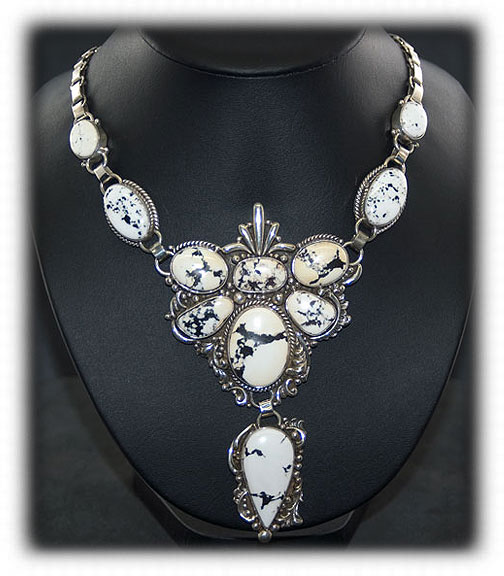
White Buffalo is a semi-precious gemstone that is white with black and sometimes brown inclusions. It is sometimes called “white turquoise” but by definition turquoise contains copper (it is a copper aluminum phosphate), which is what gives the characteristic blue color, or the presence of iron will cause the color to be more green.
White Buffalo is as hard as turquoise and polishes to a high shine, but since it has no copper and no blue color, it is technically not turquoise. It is formed from the minerals Calcite and Iron. As far as we know, the stone is found only in one mine in Nevada, which is owned by the Otteson family. (original article here)
Dry Creek Turquoise
The Dry Creek mine, which has also been known as the Godber and Burnham mine, is located in northeast Nevada. The mine has yielded both a pale blue and a cream white turquoise. The unusual white to light blue turquoise is very hard. The color is due to a preponderance of aluminum rather than copper in the stone's chemistry. The matrix is typically light golden or brown-gray to gray-black. White turquoise is beautiful alone in a piece of jewelry and is especially striking when juxtaposed with other colors of turquoise in a single creation. (original article here)

Let's remember those who started this fabulous turquoise trend.


Thank you so much for visiting us at Sonoran Style. Peace and love to all.


No comments:
Post a Comment